Character Sculpture by Brian
Here is what Brian says:
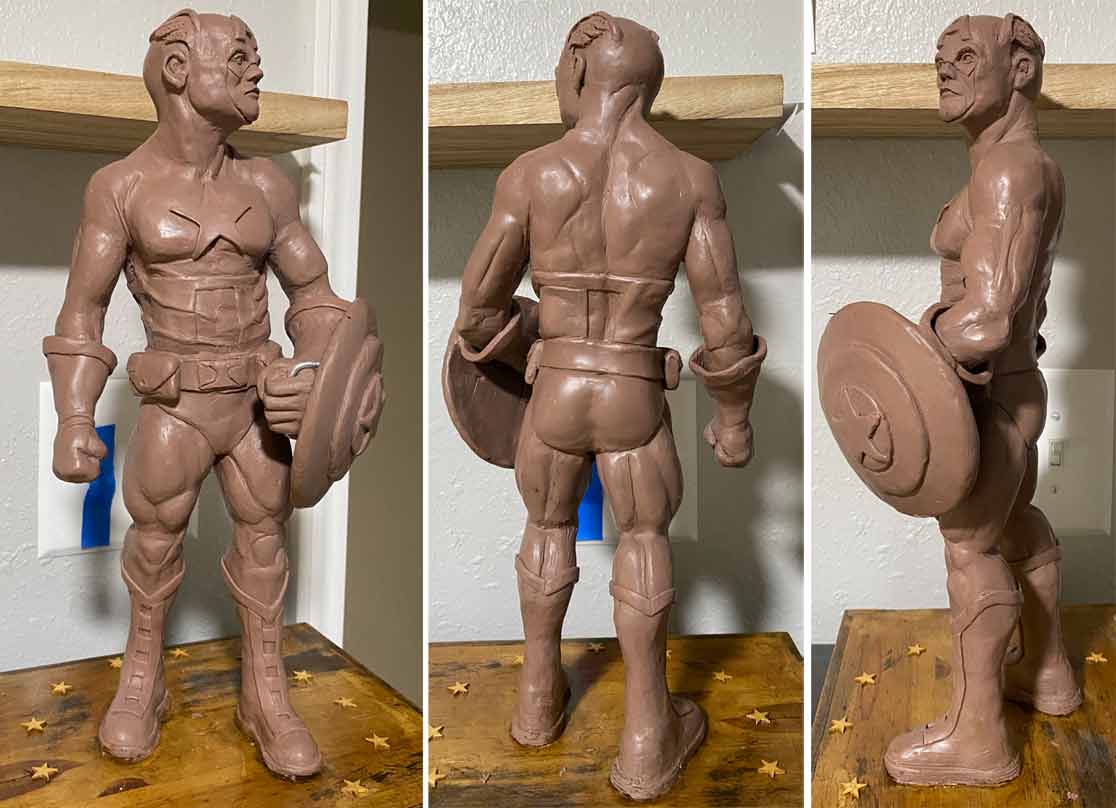
"I am a student of Life Drawing Academy and Anatomy Master Class. I have made my first sculpture using modelling clay, Monster Clay, and would like you to critique my work. The clay is easy to work with, although I find it difficult to make the surface as smooth as I would like. This is my very first attempt at sculpting anything, so I would really appreciate your opinion."
Feedback from Vladimir London, an Art Tutor
Dear Brian,
Thank you for sharing your sculpture. I like it very much, what a great piece of work! If this is your first attempt at sculpting, the result is especially impressive.
I also enjoy working with Monster Clay, and the Hard Grade is my favourite. It holds its shape well and is pleasant to work with.
Your model is already smooth enough, but if you would like to refine the surface further, you can try moistening your fingers slightly and smoothing the clay again. You may also use a well-polished metal sculpting tool with a little water to achieve additional surface refinement.
Later in the Life Drawing Academy Correspondence Course, you will work on assignments devoted to human figure proportions and anatomy for artists. Your sculpting experience will be extremely useful for these subjects because working in three dimensions helps develop a stronger understanding of form, structure, and anatomy.
Your personal curriculum also includes character design, which you will study at a later stage. However, if this subject particularly interests you, there is no need to wait. You can continue creating characters in clay or explore the same ideas through two-dimensional sketches and drawings.
The proportions of your figure may, of course, be an intentional part of the character design. Nevertheless, there are several useful classical proportions you can keep in mind when drawing or sculpting the human figure.
The midpoint of the human body is approximately at the level of the pubic bone. The distance from the pit of the neck to the pubic bone can be compared with the distance from the top of the pelvis to the top of the kneecap. A similar distance can also be measured from the kneecap to the toes. These simple relationships are useful when checking the overall proportions of a figure.
In your sculpted model, the upper leg appears somewhat too short. It looks shorter than the lower leg, whereas in the human figure the opposite is generally true. You can also compare the length of the upper leg with the height of the head. In life, the upper leg is considerably longer than the head, while in your model the head appears to be approximately the same size, or possibly even larger.
If these exaggerated proportions are intentional and form part of the character's design, then there is no problem at all. Artistic character design often relies on deliberate distortion and exaggeration. However, if these proportions occurred unintentionally, you may wish to adjust them, provided that the internal armature allows you to do so.
In any case, this is an excellent sculpting exercise, and the result is very good indeed. Creating forms in three dimensions is a valuable way to strengthen your understanding of anatomy and proportion, and these skills will support your future drawing and character-design work.
Once again, thank you for showing your model.
Kind regards,
Vladimir London
To learn good drawing techniques, enroll in the Life Drawing Academy course:
Online Course
A self-study, self-paced course for you to learn fundamental methods of classical drawing and improve life drawing skills by watching video lessons and doing assignments
- Unlimited access to 52 life drawing video lessons
- Lifetime membership without deadlines
- Unlimited support from the Academy tutors
- Constructive critique of your artworks
- Member access to the Academy's Art community
- Place in the Academy's Students Gallery
- Exclusive members-only newsletter and bonuses
- Life Drawing Academy Diploma of Excellence in your name
One-time payment - Lifetime membership
$297 USD
ENROLL NOW
Personal Tutoring Online + Online Course
The ultimate choice if you who would like to receive personal, one-to-one tutoring from the Academy teachers, which is custom-tailored to your skills and needs
- Everything in Online Course, plus:
- Dedicated team of art tutors
- Assessment of your current level of drawing skills
- Personalized curriculum tailored to your skills and goals
- Up to 100 drawing tasks with by-task assessment
- Unlimited one-to-one personal coaching with detailed per-task instructions and feedback
- Artwork critiques and results-oriented guidance
One-time payment - Lifetime membership
$997 USD
ENROLL NOW